






In our most recent episode of The BetterPears Podcast, we introduced the bête noire of this season, Big Lexi, the lexicography cartel that prints those cumbersome dictionaries, lexica, and seemingly endless online databases full of words and their meanings in short, simple definitions, which we are expected to accept without challenge or further insight. The search for meaning is metaphysical, an ontological pursuit, from which we derive ends or purposes and the moral or ethical means for achieving those ends. Big Lexi controls our moral outcomes by dominating the origin of our thoughts, the seeds of our ideas, producing unsavored fruit. You deserve better.

Our particular origin today is the Greek word “ἄνθρωπος,” meaning man or human being, not specifically a male human being as the word “ἀνήρ, ἀνδρός,” signifies but rather a being having a human nature distinct from other living and non-living beings. The corresponding Latin equivalent is “homo, hominis.” Latin, which comes to us heavily influenced by Greek, diverges here. The adjective “ὁμός” in Greek signifies sameness, which when applied as an influence to the Latin “homo” offers us something of an internal monologue in the appellation of terms. A “homo” to the early Latin speaking people was perhaps someone sharing a common nature, or so it seems, and remains for us a fruitful mnemonic device for recalling our shared humanity in a world currently poised on war.
The Greek “ἄνθρωπος” does not share this idea of sameness, but rather identifies a particularity of human nature. Composed of the prefix “ἄν-, ἄνα-” and “θρωπος,” or rather “τρόπος” from the verb “τρέπω,” the Greek term signifies a being that “stands”, literally “turns”, “up.” The immediate connection is that human beings stand on their hind legs distinct from nearly all known beasts, and not just in contests of strength and domination but in the standard course of quotidian life. Indeed, modern anthropologists have argued for the evolutionary advantage that our bipedal stance offered to our ancestors living in the grasslands of northern and central Africa both for avoiding predators and scouting our prey.
Big Lexi would have us take this definition and anthropological explanation and file it away in our mental storehouse of terminological arcana, but something is distasteful about this etymology. It strikes the investigative intellect as too simple. Were the humans who developed proto-Greek languages mindful of some pre-human ancestors earlier than homo erectus? Why did they focus on how we stand and not instead our similarly uncommon baldness among mammals? What is more striking about us, that we stand on two feet or wear the skins of other creatures over most of our body?

As temporal castaways straddling the 20th and 21st Centuries after Christ, there is no resolution in this life to this inquiry, the history into human pre-history. Yet, it is possible to seek out something quite fruitful in the word “ἄνθρωπος” and the examination of its two parts, “ἄν-” and “τρόπος.” “Ἄν-” as a prefix means both the direction “up” and the iterative meaning “again” or “back.” An ἄνθρωπος, then, is something that turns up or turns back. Similarly “τρόπος” has the locomotive meaning of turning in a direction, but it can also signify a change in moral direction, for example, in the word “tropology,” which refers to what is moral or ethical. An ἄνθρωπος, so understood, is a being that can change its moral trajectory, a being who can morally “turn back,” a moral agent who can repent.
As it turns out, human beings are the only creatures who can repent… and who must needs do so. To justify this claim, it will be helpful to revert or perhaps initially vert, for newcomers, to the hierarchy of being. At the top of this hierarchy is God, followed in order by angels, humans, animals, plants, micro-organisms, rocks, and finally pebbles. The ordering of fungi is a disputed matter and, in the interest of keeping this investigation civil, has been left off the hierarchy. In this rough hierarchy, the subset of creatures extends from angels to pebbles. The subset of creatures rebellious toward the creator is limited to angels and humans. The holy angels have no need of repentance. The fallen demonic angels cannot repent. Only fallen human beings can repent.
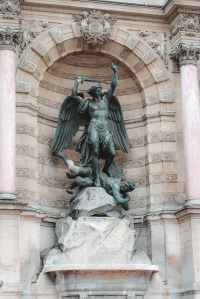
The inability of the fallen demons to repent strikes against our egalitarian tendencies. While Augustine wept for fictional Dido and not his own wretched state, so too do we weep for demons amidst our own peril. No, for a rebellious angel, repentance is impossible as a matter of matter and form. When we refer to angels, we are referring to what are called separated substances, that is, beings existing entirely as formal realities without an essential connection to matter or a bodily existence. This separation from matter means that each angel or demon is formally different from all others. Each has a unique nature as there is no common, singular angelic nature. Matter, the stuff, which receives the structure of form, logically allows for multiple beings to share the same form or nature but remain distinct on account of the differentiation of matter. For example, all sodium-chloride crystals are structurally the same, however, there exists more than one grain or ionic bond of table salt. Matter functions as a principle of differentiation among beings sharing the same form, but matter also functions as the principle of continuity despite formal change for embodied beings.
You have, most likely, seen a photograph of your younger self. Technically, every photograph of yourself is of a younger you, but in this case a photo of you over a decade ago will likely not resemble your current countenance. What connects you to that person? Bracketing for the moment the disputed veracity of philosophic solipsism, you have continuously awoken every morning since that photo was taken as the same person. There is a continuity of you being grounded in your material body which allows for formal change in your appearance and formal change in the state of your intellect and soul while remaining the same person, the same human being.

We can repent because we are that same son or daughter of our first parents made clean in the waters of baptism, that same repentant sinner who comes before the judgment seat of God seeking mercy, healing, and restoration. The new you, the renewed you, is still you, the you grounded in the body that God gave you in your mother’s womb. For Satan to repent, however, would be the annihilation of “the fallen angel formerly known as Satan” and the creation of an entirely new angelic being. His freely chosen rebellion has deformed his being irrevocably at the moment of his creation. He cannot formally change without ceasing to exist according to his nature. An example that might be easier for us to grasp is the number or rather the quantity “4.” Can “4” become “5”? We can add an additional unit to the quantity “4” through an operation of our intellects, but the nature of the immaterial form “4” never becomes “5”.
Our bodies, therefore, are something like a metaphysical hinge or focal point of our repentance and reconciliation. This import of the body is why the Incarnation of the Eternal Word was met then and still today with so much incredulity. The Incarnation of Jesus Christ protects against the temptation of dualism by affirming the goodness of matter as well as the soul, but that is a topic we ἅνθρωποι must return or turn back to on another day.

2 responses to “Anthropos (Episode 4)”
-

[…] from Latin meaning, “finger (or thumb).” Distinct from the Greek ἄνθρωπος (cf. Season 1, Episode 4, “Anthropos”), the Latin word for human being “homo, hominis,” possibly comes to us from the Greek […]
LikeLike
-
[…] on account of reason seem singular to man as a corollary of our hylomorphic nature (See Anthropos, Season 1, Episode 4). The prospect of artificial intelligence, of imposing intelligence onto machines lower than humans […]
LikeLike


So what thoughts came to mind concerning the episode?