





Classical metaphysics, distinct from the occult masquerading as metaphysics in many modern bookstores, is, despite being fretful of whatsoever divides philosophy from revealed theology, indebted to the doctrine of the Real Presence of Christ in the Eucharist and the distinctions made in the explanation of transubstantiation for the enduring interest in the four causes after the modern philosophical assault on teleology and even free will agency by the scientific materialists born from the divorce of Empiricism and Rationalism. The indebted interest for this classical remnant is not without its cautions as transubstantiation is an extreme circumstance in which not just the form or just the matter but the whole substance of a thing is changed instantaneously. Extreme cases make bad laws (and perhaps brief podcast episodes on metaphysics).

The fruit of this insight however so offered by the Eucharist in particular will be addressed in the next episode on matter and form. At present, the epistemologically prior aspect of agency and instrumental efficient causality in the sacramental order in general will take to the fore and provide an advantageous expository bridge in the causal chain from origin and end, that dual dimension of τέλος and terminus, to the manifestation of what is intended in an external substance, the “ex + facere” of efficient causality, or in more reflexive cases the coming to exist in a different mode or way of being. Whereas teleology asks, “Why anything at all?” efficient causality asks “How does anything come to be—absolutely, in mode and manner, through primary and secondary causes?”
The case of reflexive change betrays the paucity of our mother tongue regarding the broader complexity of efficient causality. English, in its contemporary parlance, masks the middle voice amid propagating the active voice over the passive in all but the academic journals and for the humans who still write in them. The middle voice is a boon and delight for the reflective student of Ancient Greek, expressing either reflexive action upon the subject’s self or in the interest of the subject, for example, when ordering servants to perform a task benefiting the master.
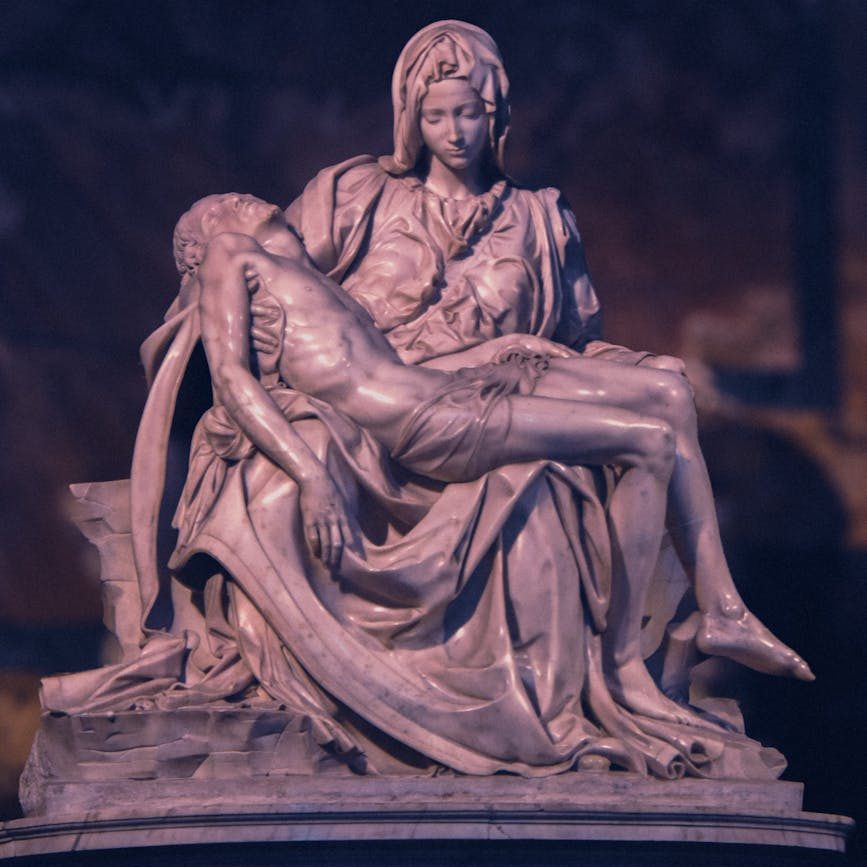
Thus creation, all contingent being, is properly indicated in the middle voice insofar as it occurs within God’s plan of sheer goodness (CCC, 1; see also “Τέλος Terminus”) and terminates in His glory when the order of His creation most perfectly participates in His Divine Life and Will. Perhaps the clearest example of this is in the middle voice verbal form ἐγένετο in John 1:14, “ὁ λόγος σὰρξ ἐγένετο,” often translated in English as “the Word became flesh.” The Anglophonic intellect correspondingly perceives the Incarnation as a rather passive act. The Incarnation, however, is a miraculous and therefore Divine Act performed by the very Eternal Word assuming our human nature through the consent and, by extension, agency of Mary, who further nourished and succored her Savior with her very body, while even still it would be His Body and Blood which would nourish her in the Eucharist. Marvelous Marian middles indeed.

Returning to the sacraments, Catholics understand them to be visible signs instituted by Christ which bestow grace. The metaphysical problem that had arisen by the 13th Century was the principle rooted in the teachings of St. Augustine that only God causes grace. How then are the sacraments, created signs distinct from God, able to bestow grace? The prevailing theory at that time, as a young friar Thomas from Aquino was rising through the ranks of the University of Paris, was termed dispositive causality and held that the minister of each sacrament merely disposed matter, that is, the sacramental signs to which God in a distinct and separate act bestowed sacramental grace upon the sacrament’s recipient.

Human conception stands as the standard metaphysical precedent for dispositive causality, in that the material contribution of the father and mother toward the begetting of offspring merely disposes or puts in place conjoined gametes which receive the newly created human soul infused by God alone and immediately either at what is now known to be conception or what was previously understood as the quickening. Without the disposition of matter by the parents, there was no natural context for the infusion of a new human soul into a body. Similarly with sacramental dispositive causality, without the enactment of sacramental signs the Divine Act of bestowing sacramental grace would be absent.

The sacraments in this paradigm of dispositive causality uphold St. Augustine’s principle that only God bestows grace, but leaves the sacramental signs as merely concurrent symbols in the natural world in a way superfluous to the underlying supernatural giving of grace and other effects of the sacraments despite some thinkers emphasizing more the necessity of such disposition.
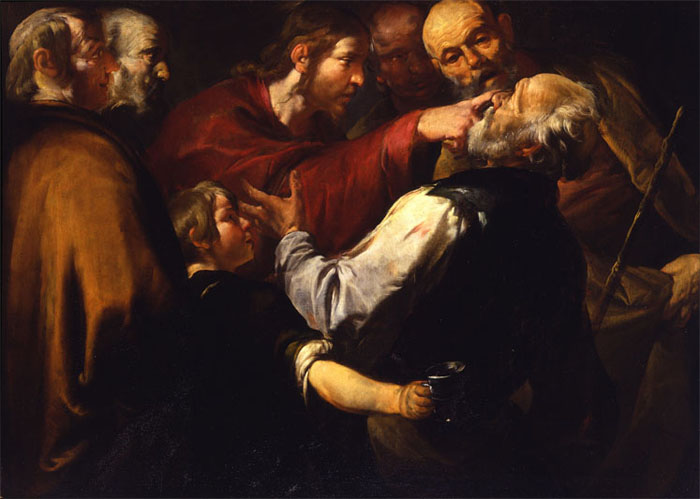
At some point after St. Thomas completed his Commentary on the Sentences of Peter Lombard and before his completion of the famously incomplete third part of his Summa Theologiae, he had a profound reflection on the account of Christ’s miracles in the Gospels, in particular, Jesus’ healing of the man born blind in John’s Gospel, “As he said this, he spat on the ground and made clay of the spittle and anointed the man’s eyes with the clay, saying to him, ‘Go, wash in the pool of Silo′am’ (which means Sent). So he went and washed and came back seeing” (Jn. 9:6–7). As God, Jesus is the author of all that is and could have healed the blindness as a direct act of His Divine Will.
This miraculous healing, however, occurs both through the Incarnation, the human nature of Christ and the mundane mundum mixed with His saliva. The poet’s task is to make every word tell. The Poet of All Poesis tells in both words and deeds (cf. Dei Verbum, 2). What St. Thomas saw in this miracle became the basis of his sacramental system of instrumental efficient causality which exists not as some specialized branch of theology but connects all Sacred Scripture and Doctrine to the purpose of God’s plan of sheer goodness—the great drama of our lives and all living beings.

Our focus at present, however, is the manifestation of an intended end, τέλος, from the intellect of the one intending to reality external to the intender. In the case of the sacraments, how does God make His grace, a certain participation in His Divine Life, present in the souls of those following him? Through the sacraments, God as principal efficient cause works through the human nature of Christ, hypostatically united to the Second Person of the Trinity, as a united instrumental efficient cause and furthermore, through the particular sacramental signs, such as bread, wine, water, oil, or the human minister as separate instrumental efficient causes to bestow the grace of a particular sacrament on its recipient.

Unlike dispositive efficient causality, St. Thomas’s mature teaching on sacramental instrumental efficient causality holds that the divine authority to bestow grace works through created realities as signifying and ministerial instruments to bring about the desired end of God as principal cause, both final and efficient. The point, the purpose, the beating heart of this distinction is that all existence is either the Creator or a creature of the Creator. Whatever rebellion each member of the human family has fomented against God the Creator, that defect in us could have been immediately restored by divine fiat instead of “fiat mihi secundum verbum tuum” (Luke 1:38). The word became flesh and dwelt among us (John 1:14), so that we might come ourselves to know and abide in Him in this life and the life to come. Not only this, but we through our sacramental initiation are deputed to the service of receiving and bestowing grace (cf. St. Thomas, Summa Theologiae, III, q. 63, a. 2). We are not merely creatures, recipients of God’s goodness, but also instruments of His grace, His goodness, His eucatastrophic gladness.

Support BetterPears Through
BetterPears Leaves
Click Here to learn more
One response to “Agent Instrument (Season 4, Episode 2)”
-

[…] Human agency and instrumentation fall within this grand teleological design and Incarnational rescue mission. We are called to further participate in the repentant renewal of the human family and the restoration of all material creation. Matter and form exist, then, in the most foundational sense, not by any action of themselves but as the frontline enactment of God’s “plan of sheer goodness” (CCC, 1). The very scandal of the Incarnation cannot be understated here. As St. Augustine remarks on the Nativity that the uncircumscribed God became contained in swaddling clothes. He who fed from His Blessed Mother’s breast offers His own Body and Blood as wayfarer’s fare. […]
LikeLike
Be the first to know when the next episode of The BetterPears Podcast arrives!
Subscribe to The BetterPears Podcast


 BetterPears
One thought on “Agent Instrument (Season 4, Episode 2)”