






This episode concerns sitting and looking, two rather innocuous acts which become adversarial and at times morally dubious with the addition of that hereby impugned prefix “in.” It should be noted from the onset that spaces between letters are something of a late luxury to script no longer written on dried parchment, pressed papyri, or even processed wood pulp. The shift for a language such as Latin from prefix to preposition and its added space was not without it merits as verbs often compounded with prefixes would shift their vowels, not only phonetically—beware the great vowel shift—but also typographically, for example “capio” becomes “incipio”, “cado” becomes “occido”, and “teneo” becomes “contineo”.

These caveats aside, the prefix “in” bears a fundamental sense of movement toward an object unimpeded by the outer limit of that object. Imagine a pugilist punching toward his adversary. The punch, qua punch, is ordered to ending not at the perimeter of the opponent’s head but in, indeed into, the space currently occupied by that head itself. From this the primary meaning of “in” includes “into” and even the adversative “against,” which is only a step away from the negative meaning of “in” as in “incoherent” (Cf. “Catholic Heresy”). The progression of meanings for “in” is not without its pitfalls. We are looking at you “inflammable,” which means both “able” and “not able to catch fire.” Nevertheless, it is the extended meaning of “in,” the adversative meaning “against” which animates or perhaps defines sitting and looking for the words “insidious” and “invidious” respectively.

The illiberal serf to Big Lexi, the lexicography cartel, will look up the Latin noun “insidia” and be satisfied with a meaning of “ambush or trap.” Little thought, if any, will be given to the very act of carrying out an ambush, particularly such treachery against one whom a declaration of war or open feud has not yet been declared. Few who have not themselves done so consider what it takes to sit and wait, to draw out your opponent from his quotidian life in order to irrevocably alter it, through such a deplorable act, an act which cowered to be performed with honor on a field of combat. To stand against, instare, an adversary is one thing, to sit against, insidere, feigning passivity for a surprise attack, is quite another.

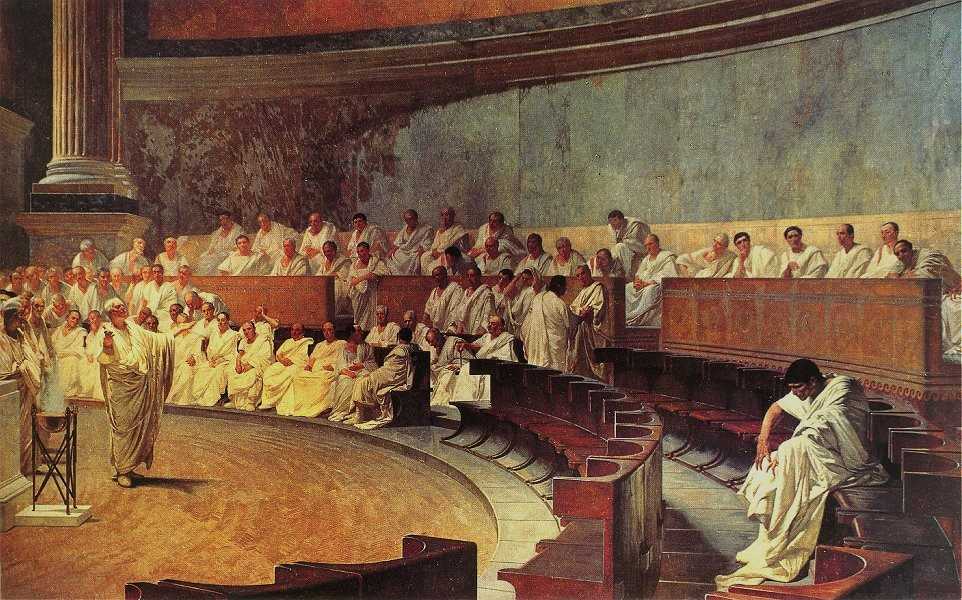
The painting Cicero Denounces Catiline by Cesare Maccari conveys like little else the disintegration of fellowship, of civil order by insidious sedition. The context of the painting is the late Roman Republic in 63 B.C., the year in which Marcus Tullius Cicero as consul uncovered a plot to overthrow the previous election by a political coup led by the senator Catiline. Cicero had hard evidence to prosecute the members of this conspiracy but he was uncertain of its extent. If a formal trial had been conducted in the Senate, perhaps the conspirators in this coniuratio would have outnumber those outside of it, in which case the Republic would already be lost. Fearful of this political trap and continued assassination attempts on his life, Cicero instead had five of the conspirators, senators of Rome, summarily executed, that is, without trial. In doing so, Cicero likely saved the Republic which would be lost in only another two decades. His career was forever marked with favor or disfavor by the consequences of such sedition and insidia.

Perhaps our modern disjunct or rather disconnection on this matter stems from our companionship, sharing bread together, holding table fellowship enclosed and therefore facing one another. Long gone are the days, and perhaps for good reason, of being served at table by waitstaff who needed ready access to you, as with the ancient Mediterranean triclinium or even Da Vinci’s Last Supper. To sit aside and abreast one another is to take in the goods of this world together and together to confront its perils. To sit opposing one another is to sit in opposition, for example, in a chess match. Modern romantic dinner dates do not so much get off on the wrong foot as the do the wrong, adversarial seat. Praise be to the opera box, the horse drawn carriage, and the rotational movement of paired dance to correct this callused calumny.

While where one sits and against what or whom one sits requires our attention, our eyes also convey and betray the disposition of the heart. Invidious invidia is currently all the rage, in markets and the public square, and likely its source. There is a difference between looking at or into someone as an adequation of the other as object or subject and looking against someone as an object of contempt or malice. Invidere, to look against, is the linguistic and ontological source of envy. Such envy precludes the sympathetic tasting of the sapiential tradition (See “Taste and See”). Envy is traditionally green, in French “vert,” because, perhaps, it asserts its own truth “veritas” or its own verdant growth—a vice, vitium, posing as life, vita (See “Two Iotas of a Difference”). In envy, the prefix “in” assimilated to “en” is both an adversarial looking against another, hating the goods another enjoys relative to the absence of those goods for oneself, the covetousness of the latter Commandments, and a looking into one’s self for justice or rather justification for this inimical animus.
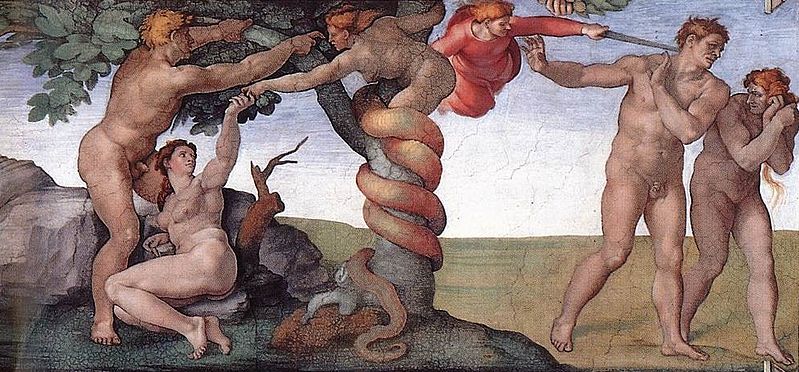
Envy robs gratitude from grace received and pollutes grace given by keeping score, by focusing on want and not what waxes. By perverting the genuine, verdant gifts of God in one’s own life by a fixation on the inequity of blessings bestowed on another in the name of truth and, by extension, justice, the invidious harm not only themselves but the common good by their iniquity.
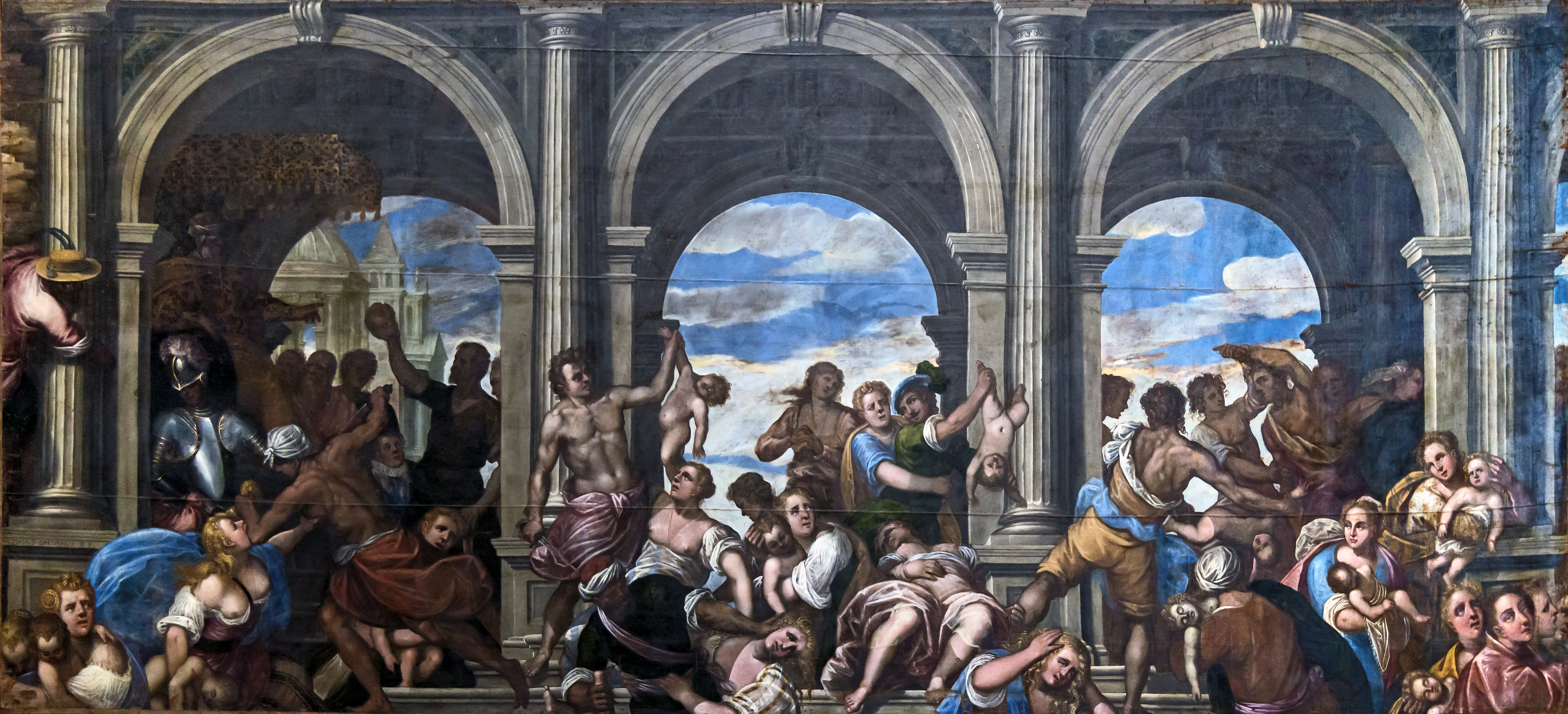
Envy is the poisoned ivy that creeps along the social lattice until the walls, moenia, and offices, munera, are engulfed in self-serving and sedition. It was for envy that Catiline conspired a conjuratio against the late republic, for envy that each Roman Triumvirate collapsed into bellum civile, for envy that the traitorous and so-called Great, Herod, so incensed by his rightful rival did command and effect the death of holy innocents.

Support BetterPears Through
BetterPears Leaves
Click Here to learn more
Be the first to know when the next episode of The BetterPears Podcast arrives!
Subscribe to The BetterPears Podcast


 BetterPears