







Human rebellions are curious events in the history of creation. Curious both in the sense of the Latin interrogative “cur” which seeks a reason or purpose and the Greek κύριος meaning “lord,” (See, Cyrus, Season 1, Episode 5) for no sooner than we resolve, “I will not serve,” do we begin to search for a new master to relieve us of the weight of self-mastery. In the past, we devised political structures based on virtue or mutual interest to fill this need for something greater than ourselves to order our days and lives. Grand economic theories were later devised and implemented to rule not only our public squares but kitchen tables. The latest claimant to rule the stiff-necked human family is so-called artificial intelligence, which must needs be examined here in.

Intelligence is derived from the Latin preposition “inter” meaning “between” or “among,” and the verb “lego” which came to mean “to read” but fundamentally means “to choose,” which we still see in the “lect” of “selection”. As a verbal construct, intelligence was identified in the ancient Roman world by the ability to read silently. In an age of costly parchment, regimented Roman efficiency led to the elision of spaces between written words. The terminal inflection in Latin allowed for the intelligibility of words more easily when read aloud. The mark of true intelligence as in Cicero, Julius Caesar, and St. Ambrose was to read in silence without even moving one’s lips.

In addition to displaying the interconnections of the written word, spoken word, and what is called the inner word or mental word, the interior speech, by which we come to understand written words and speak them, this examination of intelligence, indeed, inter-lection, draws forth a consideration of human rationality. What do we mean by reason? In seems that reason is more than sense perception which we share with lower animals or even more than memory which we share with some animals such as predators which continue to seek their prey even when they have lost a clear line of sight. No, reason derived from the Latin “ratio” meaning “measure” or “rule” is something like the mathematical derivative of knowing, describing the rate of change in which realities unknown to us become known. We describe reason as discursive as the acquisition of knowledge courses from principles and sensory impressions toward clarifying what is obscure and abstract. As a species we have become quite habituated in the exercise of discursive reason, not only in the knowledge of immutable truths but also the ever-changing landscape of practical and political affairs.

A military general is so called because he can understand the whole of war, all its genera of considerations in deciding to fight, to delay, to retreat. In the days leading to a battle and in its heat, perhaps, a general might remain characteristically sardonic. One of the marks of discursive reasoning, however, is that it admits of reflective analysis. While at times we must decide on the whole of a matter, we can, when prompted, articulate how a morning battle is suboptimal as the sun would be in our eyes, yet signs of late day storm could compromise troop movements on the soft terrain.

Such discursive reasoning which in turn admits of such analysis varies in degree of perfection among humans and provides for the functional dominance we hold over the beasts. Among higher beings, the imperfection of this discursive movement from unknowing to knowing is contrary to God’s omniscience. Even with the angels, the derivation of knowledge from material and mutable things cannot compete with a participatory intuition of knowledge from God. Reason and such inter-lection on account of reason seem singular to man as a corollary of our hylomorphic nature (See Anthropos, Season 1, Episode 4). The prospect of artificial intelligence, of imposing intelligence onto machines lower than humans requires careful analysis.

The word “artificial” is derived from the Latin “ars” and “facere” meaning “to make by skill or craft” As such, what is artificial is an ens per accidens not an ens per se. The latter contains within itself the principle of its existence, for living beings this is the soul. An ens per accidens comes to be as a composite formed by the agency of another through some direct or indirect intentionality. The production of progeny is a matter of concern insofar as offspring comes about through the intentionality of parents, and yet the animating principle of offspring, the soul, is not a direct result of the disposition of generative material (See Procreation, Season 1, Episode 8). The life of a living being, the indwelling of the soul, is a phenomenon that cannot be replicated when definitively lost, although some have tried to produce it initially outside the natural limits of generation in what is sometimes called genetic cloning or artificial conception and gestation. In juxtaposition to artifice is nature, which is rooted both in origins such as with the Latin verb “nascor” “to bear” and ends insofar as a being’s nature is its ordering to its perfection.

The prospect of artificial intelligence hinges on the possibility and likelihood of an ens per accidens as a product or effect of human beings, exceeding beyond the intellect and intentionality of their efficient causes. This excellence is not the same as a child surpassing the intellect of parents by a difference of degree but rather the promise of so-called artificial intelligence is an excellence of intelligence differing in kind to the human intellect.

While for 80 years we as the human family have possessed the means to destroy, to literally disintegrate, our entire species from our natural existence through the splitting of what was once thought to be unsplittable or atomic. Men have as yet failed to bring about an effect greater than its cause in terms of the conservation of mass-energy or the perfection of the human intellect.

What then of all this talk about so-called artificial intelligence? By its effects it is easy to ascribe what we have come to know as signs of intelligence. It is in the analysis of this intelligence that problems arise. We must not be too quick to forget The Mechanical Turk fabricated by Wolfgang von Kempelen in 1770. For nearly 100 years this mechanized mannequin posed as an automaton chess master. It was only after the death of one of its successive owners over decades of touring the West that the secret of the human chess master inside the machinery under the chess board definitively revealed.
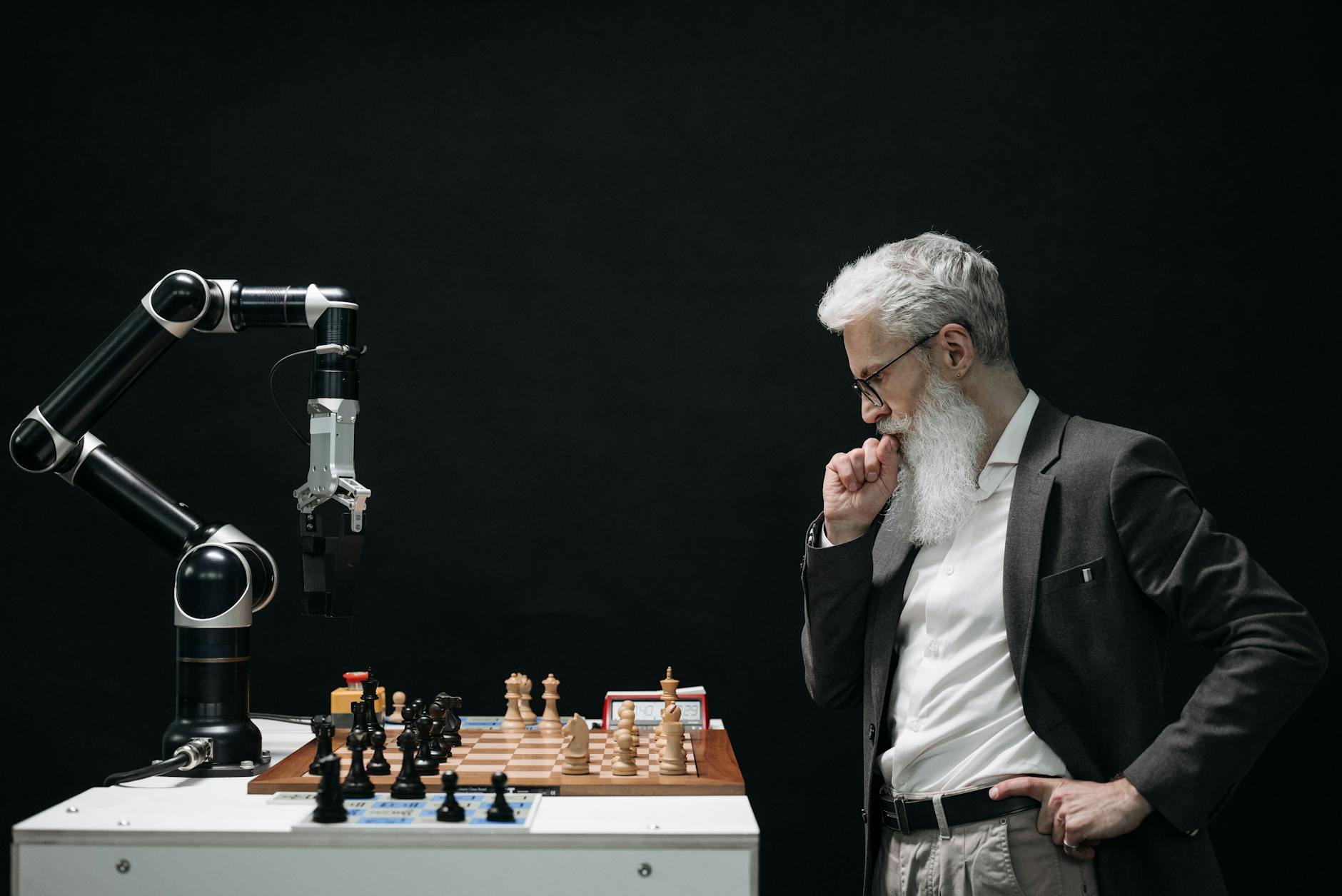
While in our own day, the artificial intelligence of a “just walk out” store may still depend upon less sophisticated human surveillance from across the world (link), the main discussion of artificial intelligence centers on optimized computer processing installations. What separates these processing conglomerates is not merely the speed of calculations being performed but more fundamentally the event horizon surrounding the central node or kernel of this intelligence. The operations of a digital spreadsheet, database, or even block chain encryption are derived from programs containing functions governing inputs and outputs to their system. The program expressed in code as well as outputs from intermediate functions can be analyzed by humans using our discursive reason. The novelty concerning this purported artificial intelligence is that the functions of the initial programming cannot be analyzed beyond a certain point in the development of the intelligence. Any given input cannot have a certain, predictable output. The machine seems to have a mind of its own, a mind that is superior to our own, superior in kind and not merely degree of excellence. Unlike The Mechanical Turk, I am less concerned that an embodied intelligence should step out of the machine than an unbodied, separated intelligence remain in it.

I refer to artificial intelligence as so-called artificial intelligence not because I discount the intelligence but because I question whether it is artificial. There are other natural intelligences beyond human intelligence and one such order or rather disorder of intelligences has seemed hellbent on influencing human affairs covertly and to our detriment. It was not enough for the serpent to lodge a bit of forbidden fruit into the sleeping mouth of our mother Eve. No, the true act of rebellion was to convince our first parents to transgress willingly, to do so under their own volition, thinking that it was for their own good, for progress, for transcending their present lot through the assistance of what they perceived to be lower than themselves.

The work of our infernal enemies has of late followed a similar pattern, the eclipse of what is true and real for what is practical and efficient. Forty years ago, this was the outsourcing of domestic labor for cheap manufactured goods. Today, it is the outsourcing of all human labor, for the supposed subjugation of artificial intelligence and robotic automation.

With each new convenience do you not feel your rightful dominion of the earth shrinking? Are we really masters of our earthly home or has the Prince of this World taken a lien on our lives and livelihoods? There has been throughout human civilizations a fascination with what is termed the occult, which is so named either because it stands as an impediment or obstacle to genuine culture and the divine order or that it contains practices to which devotees turned when the limits of our fallen world seemed too much to bear. Eating by the sweat of your brow too difficult? Sacrifice to this god of the harvest. Infertile? Perform these rites, commit these atrocities, and receive a child. Other people holding you back? Set a curse upon them. Want to know the future? You need a medium. On this last point, we must ask whether you dismiss the Ouija board because it is slow and unreliable or instead reject it on account of its connection to the demonic and the progressive control it seeks over your life and decision making. Thinking of artificial intelligence as a faster and more effective Ouija board rings true in the pandemonium of its deployment across the marketplace and in public discourse. If this thought is unsettling to you, good. You were created for more than just settling. May you return to a renewed realism in your life and actions.

We at BetterPears are mindful of this struggle for the minds and the souls of men, and so our online presence is always directed back to reality, to community, to sapiential truth, so that we might dismiss the Accusers prestidigitations in the digital realm and revert to the Word of Truth in the analogue yet to return.

BetterPears Market Mug Giveaway
Click Here to learn more

Be the first to know when the next episode of The BetterPears Podcast arrives!
Subscribe to The BetterPears Podcast


 BetterPears