







“Menial” is a charged word in present parlance near the mid-third century of the American Experiment. The word bears a prima facie pejorative connotation, perhaps as a result of the abolition of slavery in the mid-19th Century and the rise of socialism imported from the Old World that followed into the 20th Century when the term correctly or incorrectly became predicated of the labor performed by housewives.

“Menial” is an adjective derived from the Greek verb “μένω” meaning “to stand fast, remain, or abide.” A menial servant or laborer is one who lives with his or her employer or, in the case of slavery, the putative owner. What is more than simply the added or otherwise transferred expense of the employer to provide a living space and other accommodations for the menials is the certain vulnerability that the employer offers to these non-familiar residents. The intrigue of the Downton Abbey television program relied upon this tension between vulnerability, duty, and class distinction, while P.G. Wodehouse’s character Jeeves seems always to seek his master’s interests whether expressed or tacit, conscious or otherwise. Perhaps the fullest embodiment of menial service for contemporary audiences is Alfred Pennyworth of Wayne Manor, who becomes the guardian of the orphaned heir and double-lifelong support.
There is a richness in menial labor which transcends the realm of wages and compensation. Mένω is one of the verbs that fills St. John’s account of Jesus’ Last Supper discourse on the vine and the branches:
4 Abide in me, and I in you. As the branch cannot bear fruit by itself, unless it abides in the vine, neither can you, unless you abide in me. 5 I am the vine, you are the branches. He who abides in me, and I in him, he it is that bears much fruit, for apart from me you can do nothing. 6 If a man does not abide in me, he is cast forth as a branch and withers; and the branches are gathered, thrown into the fire and burned. 7 If you abide in me, and my words abide in you, ask whatever you will, and it shall be done for you. 8 By this my Father is glorified, that you bear much fruit, and so prove to be my disciples. 9 As the Father has loved me, so have I loved you; abide in my love. 10 If you keep my commandments, you will abide in my love, just as I have kept my Father’s commandments and abide in his love. 11 These things I have spoken to you, that my joy may be in you, and that your joy may be full. (John 15: 4–11 RSVCE)

The verb for “abide” is this very same “μένω” in the original Greek. Our goal or purpose in life, from the very lips of its author, Jesus Christ, is to abide in Him and so abide in the Father. That is all. The flurry of human activity in life, the wars, the commerce, the daily grind for millennia terminates either in abiding or perdition. While the latter end is a topic for a subsequent episode this season, this act of abiding or remaining should be noted at present for its status outside the norm for contingent beings. Like the 21st Century college freshmen who thinks that he or she has a high mark in a course until the professor lowers it, we as contingent human beings can mistakenly believe that our existence is necessary—so removed are we by the time we have use of reason from the time when we were not and the miracle of our conception and birth. We even talk about depending on God as if from some foundation of our own when the reality is that we depend from God as one so suspended over the abyss of non-existence save for the enduring sustenance of creation that God alone speaks forth for our being and good. In this way, remaining with God is the greatest outcome of our lives, not only on account of our sustained existence, not only on account of who God is, but also on account of what this invites us to become.

To grasp this additional reality, we turn to Christian monasticism. Notably, a monk is so called on account of his stability again from μένω and not on account of his solitary state stemming from “mono” as not all monks are hermits. Just as St. John remained with Christ at the Last Supper and at the foot of the cross but did not die at the hand of persecutors, so too did the early monk fathers who survived the Roman persecutions. These early monks contemplated how best to live the Christian life beyond the context of certain martyrdom, for without the persecution of men after the Edict of Milan, granting a few persecutorial hiccups, how could one best avoid the persecution of evil spirits and so radically embrace the Christian life?

The witness of St. Anthony of Egypt demonstrated that a life of prayer and spiritual asceticism or exercise could lead to greater holiness and increased communion with God. Later in the waning decades of the Roman Empire, St. Benedict of Nursia radically embraced the Christian life by embracing radishes, that is, through labor, which some might call menial labor, paired with a schedule of prayer. The motto or program of life for these Benedictines has since been “ora et labora,” “pray and work,” and yet I have long wondered if this motto was not a pleasant hendiadys–a grammatical structure in which one thing is expressed by two, literally from the Greek “hen”-“one” “dia”-“through” “dys”-“two”. What I mean here is that “ora” which we translate as “pray” is manifested in the monastic life through the keeping of the Divine Office. “Office” or “Officium” being composed of the Latin preposition “ob” and the verb “facio” meaning “to do or make,” that is, “work.” The prayers of the monks are the great work of their community, a work not only for their community but for the communion of the faithful beyond their walls.

Similarly, the horticultural labor of the monks remains rooted in the exhortation of every farmer that God open the seed to bring forth His harvest. In addition to this direct connection between horticultural labor and prayer, there is the puzzle of how the root “lab” enters our diction in the West. It appears as a readymade verbal construct in Golden Age Latin, “laboro, laborare,” but did it derive from the Greek “λαμβάνω, λήψομαι, ἔλαβον,” meaning “to take hold, grasp, seize”? In addition to explaining why a fugitive is said to be “on the lam” because he (or she) has taken or seized liberty that has been duly lost to them, this connection with labor would correspond initially to our human use of tools that must be taken up in the course of work. Even bestial labor seems to require some yoke or harness to be taken up. Further, this word origin would correspond to the economic argument of Pope Leo XIII for the right to private property in his 1891 encyclical Rerum Novarum, “As effects follow their cause, so is it just and right that the results of labor should belong to those who have bestowed their labor (10).” Labor, so it seems, extends ownership to its results, a certain participation or partaking, in the literal sense, of the created order.
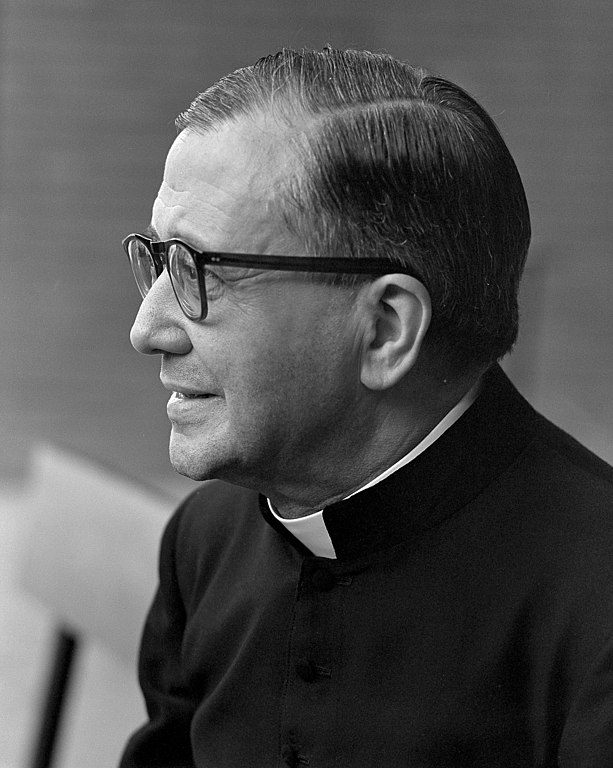
While Karl Marx would tend to conflate the worker and his labor and assess the value of the former by the quality or quantity of the latter, St. Josemaría Escrivá like his patron St. Joseph would recognize that even in the productive way of life there is an opportunity to affirm and perfect the practical and political way of life. By this admittedly superimposed Aristotelian schema, I mean that even in the production of things external to us such as food, garments, and widgets, there is an opportunity to improve ourselves as the one producing both in our excellence of skill and the reason or purpose for our labor, on the one hand greed, pride, or envy, on the other hand to care for your spouse, to feed your hungry child, or simply for the greater glory of God. The intention of our labor, menial or otherwise, is the optic for Opus Dei, the Work of God, by Him, through Him, and for Him.
This has all be a long way of arguing or more properly suggesting that our goal is to become menial laborers in God’s house, not because I deny the adopted sonship of my baptism but because remaining in God, abiding in Him, is participatory for us in this life and the next through labor. Labor is a taking and not merely a giving. In labor we wed our intention and action to the good produced externally or internally. In the case of latter, we find ourselves enmeshed in others through a communion of the common good.


Be the first to know when the next episode of The BetterPears Podcast arrives!
Subscribe to The BetterPears Podcast


 BetterPears