
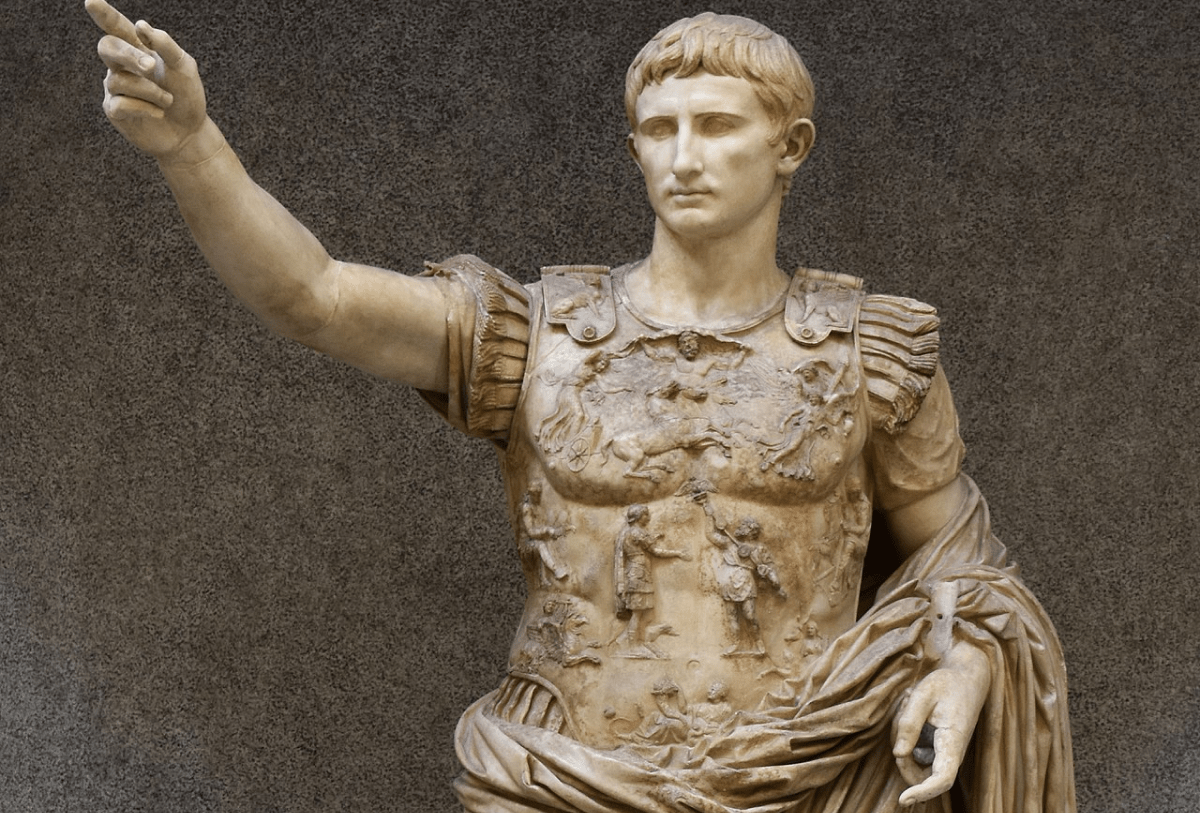






Idiomatically, “bellum gerere” is rendered “to wage war” in English; however, the literal sense is “to wear war” or “to bear war.” Wearing war is an important nuance in the world of the ancient Romans who thought of themselves or at least projected themselves as the people of the toga and by extension the people of peace (cf. Vergil, Aeneid, I, 282). The toga as some might know from personal experience requires the fixing of the left arm to the chest in order to retain the elaborate fold or “sinus” of cloth from falling off the left arm or otherwise unraveling.

No, when the Romans went to war, they literally went out of Rome proper taking off the toga to put on their breastplates and other armor of war, assembling on the Campus Martius, the field dedicated to Mars the god of war. In this way, the Romans wore the clothes of war when they waged it. Indeed, military presence within the walls of Rome was strictly limited to military triumphs celebrating a general’s victory and defense of the city itself as in the Second Punic War. Such exceptions required an act of the senate during the republic and later the emperor. The mixed dress of Augustus Primaporta, the famous statue, bearing both military breast plate and toga is an intentional fashion faux pas which came to signify the Pax Romana, the Roman Peace, which was founded on Roman military strength.
“Bellum gerere” remains of philological interest to us in part because the meaning of war was transferred from the noun (or substantive adjective) “bellum” to the verb “gerere” in later Romance languages derived from Latin. War is expressed in French, “guerre,” and in Italian, Spanish, Portuguese “guerra,” with nuance variations in pronunciation. Our anglophonic audience might be aware of the term guerilla warfare which, as the diminutive form suggests, employs small skirmishes or “little wars” instead of large pitched battles to achieve military objectives.

The shift in meaning from “bellum” to “gerere;” however, was not the first in this Latin expression of war. The Latin noun “bellum” is perhaps more a substantive adjective derived from the three-termination adjective “bellus, bella, bellum” meaning “beautiful.” I suggest that both this adjective for beauty and the noun for war are derived from or are somehow etymologically related to the Greek verb “βάλλω” meaning “to throw, cast, or hurl.”

“βάλλω” persisted in Romance languages through the noun for “ball” and interestingly the verb “ballare” in Italian and “bailar” in Spanish meaning “to dance.” Ballerinas and ballerinos throw themselves or their partners respectively. In a strange confluence of meaning, the dance fighting of the original theatrical production of West Side Story or the music video for Michael Jackson’s “Beat It” are a beautiful belligerent ballet. In reality, the connection is something of a mismatch. War disfigures what is beautiful in both body and soul. The trauma suffered and persisting for our veterans should give us pause and incite gratitude for their loss. War is neither sweet, nor becoming, nor beautiful.

Throwing, in the sense of βάλλω and ballistics is nonetheless ordered and by this sense founded in beauty. The beauty of ballistics is parabolic in the sense that a projectile’s center of gravity follows a parabolic flight path given the second half of Newton’s first law of motion that an object in motion remains in motion at constant speed and in a straight line unless acted on by an unbalanced force. Add to this the unbalance (and overwhelming) constant acceleration due to gravity on earth, and a projectile’s flight path becomes relatively predictable, if wind resistance is minimized (or ignored to the annoyance of every engineer ever). The flight path is even graphically predictable as it is symmetrical along the vertical axis of its zenith. The term “parabolic” can be rendered “alongside the throw” as if one were viewing a projectile from a right-angle cross-section perspective. What goes up, must come down, and it comes down at an inverse trajectory and acceleration to its upward launch.

This observable reality of ballistics made it possible to anticipate trajectories for arched arrows and catapults long before Leibniz and Newton discovered calculus and had cookies and something known as “fruit and cake” named after them respectively. So observable and predictable was this parabolic arc that archery as a skill or science was likely named for this arching ballistic property and not the shape of the curved bow, despite what Big Lexi might argue.

Returning to the meaning of “bellum,” it is no little matter to take the ordered beauty of nature and apply it to the disforming, disfiguring theatre of war. Was the expression “bellum gerere” an intentional oxymoron, pithy sardonic humor to sooth the wounds corporeal or otherwise required to found and defend Rome? Rome, an earthly city, was born in bloodshed as St. Augustine argues in the City of God. Perhaps instead “bellum” is to be “born” as in carried as a burden, as one carries and preserves what is beautiful and treasured in life.
There is a beauty and goodness of hearth and home. The beauty of mothers, sisters, and wives for which men will endure great trials, suffering, and sacrifice to protect. There is a beauty, an ordered disposition of being and act, to a son growing into a man, wielding at last his father’s sword and stringing with focused attention his father’s bow. Si vis pacem, para bellum.

The Hippocratic Oath Mug – On Sale 1/20–1/21/2024

Be the first to know when the next episode of The BetterPears Podcast arrives!
Subscribe to The BetterPears Podcast


 BetterPears