






Λήθη (lēthē) in classical Greek and Roman mythology is one of the five rivers of the underworld. It is associated with forgetfulness, and it was understood that all shades or souls must drink from this river and forget their earthly lives before passing deeper into the realm of Hades. Λήθη has come to mean “forgetting, oblivion, forgetfulness” and runs in opposition to its alpha privative, ἀλήθεια (alētheia), meaning “truth, revelation.” The norm in this arrangement therefore seems to be on the side of oblivion, while truth is a certain undoing of this process. It is as if Ancient Greek was ready-made for Platonic Recollection Theory in which we had direct experience and knowledge of the forms before we forgot them during the imprisonment process of our embodiment and birth as infants.

If forgetting is more the default state of existence and decay, what, then, is memory? Generally speaking, the Schoolmen understood a distinction between the active intellect and the passive intellect. The active intellect is the intellect in act, that is, thinking, knowing, or understanding something. Technically, when the intellect is not performing this act of thinking, it as an immaterial reality ceases to exist and exists only, as one might say, in potentiality. Still, our experience is that there is a ready disposition of the intellect to call to mind again, that is, recall imaginative or other cognitive experiences without additional stimulation of the senses. This disposition to recall previous activity of the active intellect is known as the passive intellect or memory. Since a particular memory, when remembered, is no longer potentially remembered but actively remembered, we cannot directly inventory our memory. In school we either took or gave tests depending our which side of the teachers desk we sat or on which side of the Atlantic we lived. Romance languages tend to express testing as giving a testament rather than taking. In both cases, the purpose of the test was to isolate whether memories as the habitual disposition to recall previous thoughts had indeed been habituated in students.
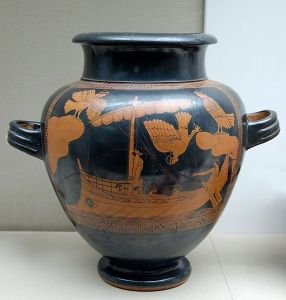
The modern siren’s song of cloud computing is the promise that all our spontaneous data in life are able to be collected and readily queried from a system of interconnected databanks. Without close reflection, we might assess that we have at our disposal all the collected wisdom of ages through the device inhabiting our pocket just as a century ago someone might have believed Big Lexi, the lexicography cartel, that all the world’s knowledge was possessed through a dictionary and encyclopedia sitting on the shelf in the study. This replacement of memory and oral tradition by the written word goes back to the Plato’s Phaedrus and the Faustian bargain to let thoughts endure the little death of being committed to writing opposed to human memory so that the great volume of things to be remembered would not grow to eclipse our mnemonic attention.

I say “little death” because like sleep, writing something down seems only to postpone a natural gravity toward loss and oblivion prior to the resurrection. By nature, however, forgetting is associated with passing and death in that the dead are no longer present to us and remain present only through memory and oral tradition in pre-literate cultures. For this reason, new life was given the names of the dead, so that the living might allow the dead, their virtues, and achievements to endure, if by nothing else, through a shared name. While Biblical genealogies and the Iliad’s catalogue of ships in Book II survived the editor’s bin of history to our puzzlement today, it should be remembered that these individuals and societal connections meant something to the fabric of our forefathers’ worldview.

Catalogues or inventories can be helpful in understanding ourselves and measuring our change. As we begin a new calendar year, I suggest a catalogue of your memories. Find a journal or notebook and begin writing everything you remember. These can be sublime truths such the 23rd Psalm or simply your childhood phone number. The paucity of phone numbers that I know from memory always makes me question how connected I really am should I lose my phone or the internet. Add to your catalogue any memorized poetry, prose, or mathematical proofs, followed by language paradigms, the periodic table, and a Mercator projection of the contiguous 48 states. Add to you catalogue birthdates, blood types, and baptisms—whatever you can rescue from oblivion.

After several rounds of coffee or green tea, take a look at your catalogue and assess it, or rather yourself. What would you like to carry with you each day for emergencies, for consolation in times of trial, for remembering who you are as a child of God and adopted heir to the kingdom? List these additions to your catalogue and make a plan to acquire them. Finally share this plan with someone you respect, trust, and who can hold you accountable.
As founder of BetterPears I am in danger of projecting myself as some authority on Latin or Ancient Greek. The truth is that I am more an amateur of Latin and Ancient Greek than a professional, that is, I love the languages and their ancient wisdom recovered in their study more than I profess proficiency or mastery in my analysis. BetterPears was born out of recognizing not how much I knew but how much I had forgotten and a realization that only through a fellowship with others to a mutual end could such a remedial reminiscence occur.

Be the first to know when the next episode of The BetterPears Podcast arrives!
Subscribe to The BetterPears Podcast


 BetterPears