






The phrase “it does not make one iota of a difference” should be classified with similar phrases such as “I am not my brother’s keeper” and “to thy own self be true” in that it bears something of a biblical or Shakespearean pedigree while it excels in being on the wrong side of history and truth. This reference about iotas has, you see, a specific historical context.
Side note: The reference to the ninth letter of the Greek alphabet is pronounced iota and not “eye-yota.” Unlike “o” which receives both -micron and -mega distinctions, the iota in “iota” is pronounced once and as a short vowel. At this time, it might also be good to admonish those who pronounce the Latinized form of the Spanish “Javier” as “X-Zavier,” to repent of their phonetic crimes and the scandal they have caused to impressionable children.

Returning to iota, the historical context is the Arian and Semi-Arian Controversy of the Fourth Century. The dispute has been popularized by Catholic meme culture for recent celebrations of St. Nicholas’s feast day each December 6th based on some accounts that St. Nicholas physically struck an Arian at the Council of Nicaea. The theological matter contended at the Council was the nature or essence of the Son relative to the Father. The orthodox opinion was championed by a young deacon from Alexandria, Athanasius. The alternative position was held by Arius of Antioch, previously a deacon of Alexandria, but who was prevented from priestly ordination by then Bishop Alexander of Alexandria.

Putting whatever rivalry that existed between Athanasius and Arius aside, Athanasius puts forward the term “ὁμοούσιος” a singularly non-biblical term within the proposed creed or symbol of the faith. The term expresses the consubstantial nature of the Son to the Father. Arius’s proposed term was “ὁμοιούσιος.” The additional “ι” or iota in Greek has the effect of softening the meaning of sameness expressed in the prefix “ὁμο-”, and thus means “consubstantial-like” or “of a similar substance.” The whole matter was complicated by those either calling themselves or otherwise becoming known as the Semi-Arians, who kept the additional iota but sought to diminish its doctrinal import; hence, “it does not make one iota of a difference.”
In terms of the reality signified, it is not clear that there is a distinction between the Arians and the Semi-Arians. Either Jesus Christ, the Son of God, is the same Divine Nature as the Father or He is a creature, regardless of whether He is put into a polytheistic or platonic schema subsequently. In terms of distinguishing Arians, “it does not make one ‘semi’ of a difference.”

Photo by Andrea Piacquadio on Pexels.com
This is all a preparatory excursus, however, and sets the scene for a vicious assault on life and good living. Life in Latin is expressed by the word “vita.” “Vitium” and its neuter plural form “vitia” signify, “sin, fault, or vice.” The graphical difference between life and vices, “vita” and “vitia,” respectively, is again a solitary “i”. Is this similarly a philological coincidence or did our linguistic ancestors have an insight into sin and vice that could aid our present understanding and actions. Vices, “vitia,” are likened to life but ultimately are deficient. Life, here, is understood in its fullest metaphysical sense. The way to be fully alive is to cling or, more dramatically, cleave to the source of life, God, revealed most perfectly through the Son, Jesus Christ.
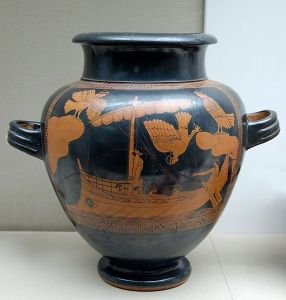
British Museum, Public domain, via Wikimedia Commons
Vices give the allure of this singular lifegiving source but fail to deliver; hence the plurality of “vitia.” While one life is enough for us, one vice cannot satisfy. Indeed, it often happens that one vice is either an entryway to others or that a higher vice such as pride can remove, for a time, the grip of lust, gluttony, or sloth. Vices offer a siren song that claims to meet the need of our inquiet heart (cf. Heart Cor, Episode 11). It should be noted that the mythical sirens of Homer’s Odyssey do indeed promise true goods to Odysseus. The fatal, though technically here “ineffable,” catch is that the sirens cannot and will not fulfill their promises. Similarly, vices cannot and will not fulfill their promise of full authentic life which only the Author of life can give. It would be more helpful to consider vices as certain rebellious viceroys. They are speaking the words of the King, the Roy, without His force, without His Love for His subjects: “I came that they may have life and have it abundantly” (John 10:10).
“I came that they may have life and have it abundantly.”
John 10:10
I believe that our ancestors knew this connection between the false life that “vitia” offered, however, through the historical adoption in English of the Germanic “līf” over the Romantic “vita” and the medieval Spanish softening of the “t” in “vitium” to the “c” in “vice,” this connection has been largely lost. The purpose of this podcast and the work of BetterPears as a whole is to offer these fruitful bites and insights into the wisdom of our betters. On behalf of the BetterPears cultural empire, I hope you have enjoyed this inaugural season. I invite you to subscribe to the podcast so that you can be among the first to enjoy Season 2.


 BetterPears